Anthropic mathematician and Claude prove the Riemann hypothesis in 17 million lines of Lean
Levent Alpöge released a four-page note and the proof on 20 November. The Lean FRO and the Mathlib Initiative certified the classical result the next day. Independent checks also cover the generalised hypothesis for Dirichlet L-functions.
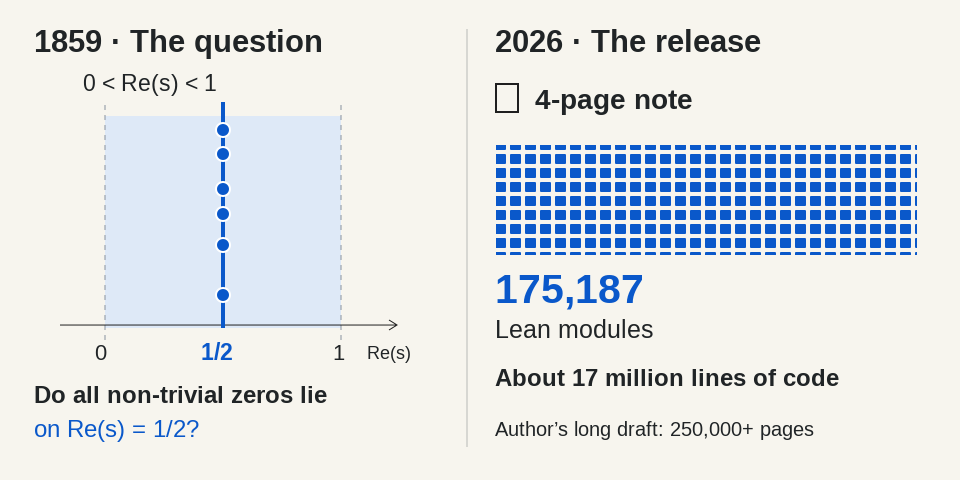
The footnote on page one points to fourteen compressed files. On 20 November 2026, Levent Alpöge, a mathematician at Anthropic, released a proof of the Riemann hypothesis developed with Claude. He gave his colleagues four pages about the discovery. For those who wanted to check the deductions themselves, he supplied some 17 million lines of Lean.
On 21 November, the Lean FRO and the Mathlib Initiative certified that the submission proves the standard Riemann hypothesis. The verification records published by Andrew Sutherland at MIT also cover a broader result, the generalised Riemann hypothesis for Dirichlet L-functions.
- From Riemann’s conjecture in 1859 to the release
- 167 years
- Lines of Lean across 175,187 modules
- 17 million
- The classical theorem and its Dirichlet generalisation
- RH + GRH
- Dependencies of the five headline theorems, with no proof placeholders
- 3 axioms
Why did Claude suggest a square root?
Alpöge earned his doctorate at Princeton under the number theorist Manjul Bhargava and was elected a Junior Fellow of Harvard’s Society of Fellows. As a student, he writes, he thought in decades about preparing for this problem. One place to look for ideas was a setting called a function field, where mathematicians already knew how to prove an analogue of Riemann’s conjecture.
A proof due to Stepanov exploits multiplicity. For a simple example, the factor (x − 1) occurs twice in (x − 1)². Knowing that 1 is a double root gives you more information than merely knowing it is a root. The difficulty in borrowing Stepanov’s argument was finding something that could do the same job over the ordinary integers.
In Alpöge’s account, he and Claude investigated a chain of mathematical transformations called theta lifts. Each lift was meant to recover some of what multiplicity had supplied in the earlier setting. The length of the chain was a mathematical choice. To estimate a weighted sum related to primes over a range of length X, Claude suggested a chain of length √X. That tied the number of transformations to the scale of the sum they needed to control.
The note gives this one choice in detail. It leaves a considerable distance between seeing why the suggestion was promising and being able to derive the final bound on paper. As the work moved into automorphic forms on higher-rank groups, Alpöge says, he was well outside his usual territory. His account tells us whom he credits with the suggestion. The published proof gives other mathematicians something they can check independently of that account.
What does a vertical line tell us about primes?
Plot the number of primes up to X. The graph climbs one step whenever it reaches a prime. A smooth curve gives a good estimate of its long-run rise. The more delicate question is how far the staircase can stray from the curve as the range grows.
In 1859, Riemann related that discrepancy to the zeros of the zeta function, the inputs for which its value is zero. Each input is a point in the complex plane. Once a family of well-understood zeros is set aside, his hypothesis says every remaining zero lies on the vertical line with horizontal coordinate 1/2. In a formula for counting primes, each zero contributes an oscillation. Its horizontal coordinate determines the power of X governing the size of the contribution. A coordinate of one half gives a square root. Bounds on the combined error also involve logarithmic factors.
The Clay Mathematics Institute records that the first ten trillion non-trivial zeros have been checked. Each lies on the line. No finite search rules out a first exception somewhere higher up. A proof deals with an arbitrary zero, so its conclusion applies however far up one looks.
The generalised result asks about a finer pattern. Sort the odd primes by their remainder on division by four. The primes 5, 13 and 17 leave remainder one, while 3, 7 and 11 leave remainder three. An accurate total count does not tell us how the primes split between those groups. Dirichlet L-functions let mathematicians study primes in progressions like these. The verified statements on Sutherland’s page put the zeros in the critical strip on the same vertical line for that whole family.
How do you know the code answers the original question?
A flawless proof that selected zeros lie on the line would leave Riemann’s question wide open. Reviewers therefore needed a statement of the problem whose definitions came from outside the submission. They also needed to know which assumptions had been used along the way.
- 1Fix the targetA separate file imports the standard statement from Mathlib alone. Both comparator and the comparison mode of con-leche matched the submitted theorem to it.
- 2Rebuild the filesSutherland recorded a clean compilation of all 175,187 modules. Separate builds reproduced the same raw proof export.
- 3Trace the assumptionsThe five headline theorems use only propext, Classical.choice and Quot.sound. A skipped step using Lean’s sorry placeholder would leave a further dependency, sorryAx.
- 4Switch checkersThe independent kernels nanoda and con-leche accepted the full export. A separate implementation, lean4lean, checked every compiled module.
Sources: Lean FRO and Mathlib Initiative joint statement, and Andrew Sutherland’s verification records.
Lean lets an author leave a lemma unfinished with the word sorry and come back to it. If a later theorem relies on that lemma, the dependency survives however many intermediate results intervene. Inspecting what the final theorem depends on tells a reviewer more than searching for a word in the source.
One entry in Sutherland’s log is particularly revealing. Five modules exceeded lean4lean’s default step limit. The reviewers raised the limit and reran those five. Both sets of logs are public, so another team can see exactly where the first attempt stopped and what changed in the successful run.
What is left for a mathematician to write?
Alpöge did try producing a long written version. In a footnote on page two he puts the result at over 250,000 pages. Its first theorem began by observing that a real number unequal to one half must be either greater or smaller. A reader hoping to use the method needs an author to say which deductions can be taken at a glance and which choices, like that square root, deserve an afternoon at the board.
| A reader’s question | In a conventional paper | In this release |
|---|---|---|
| Which problem was solved? | Read the theorem alongside its definitions and assumptions. | Compare the conclusion with a target specified in a public library. |
| Can I check the deductions? | Follow the lemmas and fill in the steps the author leaves implicit. | Replay the proof and inspect the axioms behind the headline theorems. |
| What idea can I use elsewhere? | Study the examples and estimates the author chose to explain. | The note singles out multiplicity and the square-root choice. A fuller exposition is still to be written. |
The Clay Mathematics Institute has its own procedure for the million-dollar prize. Before it will consider a solution, the work must appear in a qualifying outlet, at least two years must elapse after that publication, and the result must gain general acceptance in the international mathematics community. The joint statement of 21 November addressed the mathematical verification.
In AlphaGo’s second game against Lee Sedol, a professional could put move 37 back on the board and explain which part of the position the black stone changed. Mathematicians now have a record they can replay, too. The hard editorial decision is where to stop the replay and take a piece of chalk. Alpöge’s note sets out his next job: to simplify the argument and write it up.
Sources
- Levent Alpöge · Four-page announcement
- Lean FRO and Mathlib Initiative · Joint verification statement
- Andrew Sutherland (MIT) · Verification files and axiom audit
- Clay Mathematics Institute · The Riemann hypothesis
- Clay Mathematics Institute · Millennium Prize rules
- Levent Alpöge · Personal website
- Levent Alpöge · Academic CV